
ENERGY & GEOPOLITICAL INTELLIGENCE

Rockway Advisory Special Report : Oil & Energy | March 11, 2026
India's Energy Reckoning Has Arrived
India's Energy Reckoning Has Arrived
The Hormuz blockade is not a distant risk scenario. It is today's reality, and India is more exposed than it has ever been.
By Rockway Advisory Research Desk - Energy, Geopolitics & Risk Practice
KEY NUMBERS AT A GLANCE
Brent Peak: $119.50/bbl | USD/INR: ₹92.35 | India's Imports via Hormuz: 50% | SPR Cover Remaining: ~40 Days | Households at LPG Risk: 330 Million
On February 28, 2026, coordinated US-Israeli airstrikes on Iranian nuclear and military infrastructure triggered the single most consequential energy supply disruption since the 1973 Arab Oil Embargo. Within seven trading sessions, Brent crude surged from $73 to a peak of $119.50 per barrel. The Iranian IRGC declared the Strait of Hormuz closed to Western-allied commercial shipping. Over 200 vessels are stranded in the Persian Gulf. Thirty-eight of them are Indian-flagged ships, carrying more than 1,100 Indian sailors.
For India - the world's third-largest crude importer, sourcing 87% of its oil externally - this is not a geopolitical headline. It is an acute, structural emergency. And in our assessment at Rockway Advisory, India entered this crisis more exposed than it should have been.
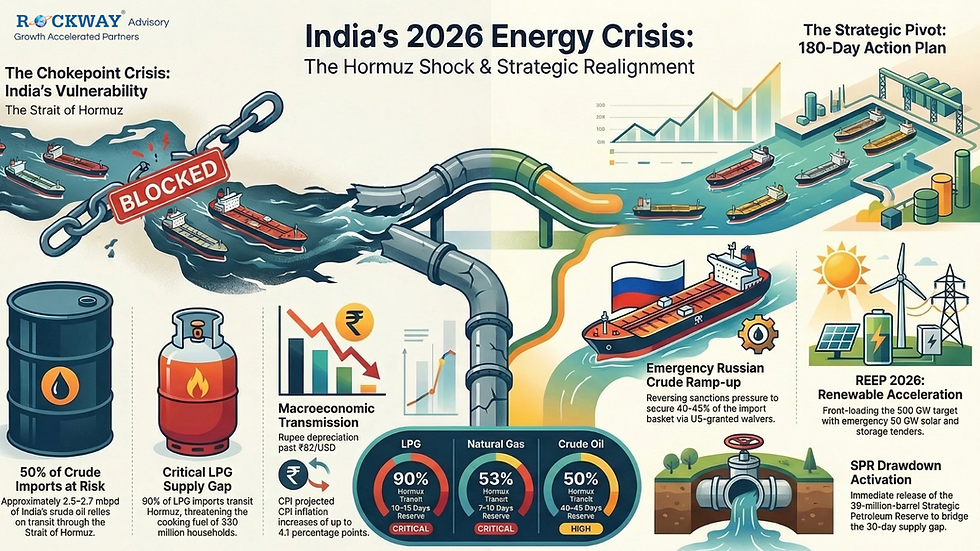
Approximately 50% of India's crude imports and 90% of its LPG imports transit the Strait of Hormuz. This concentration of dependency through a single 21-nautical-mile corridor was always the central vulnerability in India's energy security architecture.
THE BLOCKADE MECHANISM

It Isn't Physical. It Doesn't Need to Be.
A critical misunderstanding in mainstream coverage is that the strait must be physically mined or militarily sealed to constitute a blockade. It does not. What Iran has achieved is a functional blockade through three simultaneous mechanisms: the collapse of war-risk insurance (premiums at six-year highs, making transit economically unviable), the withdrawal of major shipping lines including MSC and Maersk, and explicit IRGC warnings that Western-allied vessels risk direct military action.
Even if Iran announces a ceasefire tomorrow, the insurance lag, mine-clearance operations, and shipping company re-entry protocols mean flows will not normalise for at least two to six weeks. The functional disruption outlasts any formal announcement.
Key Crisis Metrics:
OMC Stock Decline (Mar 9): -8.7% (HPCL single-day fall; UBS downgrade to Sell)
LPG Import Hormuz Exposure: ~90% (India imports 67% of total LPG consumption)
Projected CPI Shock: +2.6 to +4.1 percentage points (full transmission in 3-6 months if sustained)
CAD Widening Risk: +2 pp of GDP (from ~1.2% to ~3.0-3.5% of GDP)
THE OMC CRISIS
HPCL Is the Sharpest Point of Pain
Among India's three state-owned Oil Marketing Companies, HPCL stands out as the most critically exposed. Its marketing-to-production ratio of 2.2x, meaning it sells 2.2 barrels for every 1 it refines, creates a catastrophic leverage effect when marketing margins collapse under a retail price cap. UBS has downgraded HPCL to Sell with a target price cut from ₹540 to ₹340, implying a 37% reduction, and projects a 46% cut to FY27 earnings. IOC and BPCL are under comparable, if less extreme, pressure. The OMC sector is, in our view, the most immediate flashpoint for government fiscal intervention.
ROCKWAY ADVISORY ASSESSMENT
The strategic irony of India's current position is acute: US pressure over 2024-25 to reduce Russian crude imports, which would have kept India's Hormuz exposure lower at ~35%, contributed directly to heightened vulnerability in a crisis triggered by US military action. India's energy predicament is, in part, a consequence of responding to US geopolitical pressure.
THE RUSSIA PIVOT
Moscow Is Now India's Most Indispensable Energy Partner
The US Treasury's 30-day sanctions waiver, issued March 6, allowing Indian refiners to purchase Russian crude already in international transit, represents one of the more extraordinary reversals in recent energy diplomacy. Having spent 18 months imposing punitive tariffs and sanctions pressure to reduce India-Russia energy ties, Washington has now voluntarily created space for India to urgently reverse course. Indian Oil Corporation and Reliance have already moved to procure 30+ million barrels of Russian crude under the waiver.
India's government was unambiguous: the PIB statement declared that India "has never depended on permission from any country to buy Russian oil." Kpler analysts project India's Russian crude share will return to 40-45% of the import basket, effectively erasing two years of US sanctions diplomacy in a matter of weeks. Russia has achieved, through this crisis, a structural deepening of its energy relationship with India that no amount of diplomatic outreach could have accomplished independently.
THE STRATEGIC IMPERATIVE
Crisis as Catalyst: The Only Acceptable Outcome
At Rockway Advisory, our view is clear: the correct response to this crisis is not merely tactical procurement management. It is the permanent restructuring of India's energy security architecture. The 500 GW renewable energy target must be front-loaded by at least two years. Strategic petroleum reserves must be expanded from 40-day to 90-day IEA-standard cover. LPG import diversification, away from Hormuz-transiting Gulf sources toward US, Australian and domestic alternatives, must become policy, not aspiration.
The economics are now unambiguous. At Brent $116/bbl and petrol approaching ₹150/litre under uncontrolled pricing, the cost-competitiveness of solar, EVs and green hydrogen is not a future projection. It is today's financial reality. The crisis has done in ten days what years of subsidy reform debate could not: made energy self-sufficiency the most economically rational path for India to pursue.
"Nations that are shaped by crises are those that fail to anticipate and prepare. Nations that shape crises into catalysts emerge stronger. India has the depth, the industry, and the technology to make 2026 the defining moment of its energy independence journey - if it acts now, decisively, and at scale."
Closing finding, Rockway Advisory India Oil & Energy Crisis Risk Report 2026
Our full report, covering the Hormuz blockade mechanics, three-scenario modelling, granular OMC financials, a 16-item risk heat map, and a 180-day strategic action plan, is available to clients and institutional subscribers.
Rockway Advisory · Energy, Geopolitics & Risk Practice
This post is an editorial summary of the Rockway Advisory India Oil & Energy Crisis Risk Report 2026. The full report is available to institutional clients. Data sourced from Kpler, UBS, S&P Global, Rystad Energy, EIA, Bloomberg, and proprietary Rockway analysis as of March 11, 2026. This does not constitute investment advice.


Comments